Paper Bags and Patent Gold: The Night-Shift Dreamer Who Revolutionized America's Kitchens
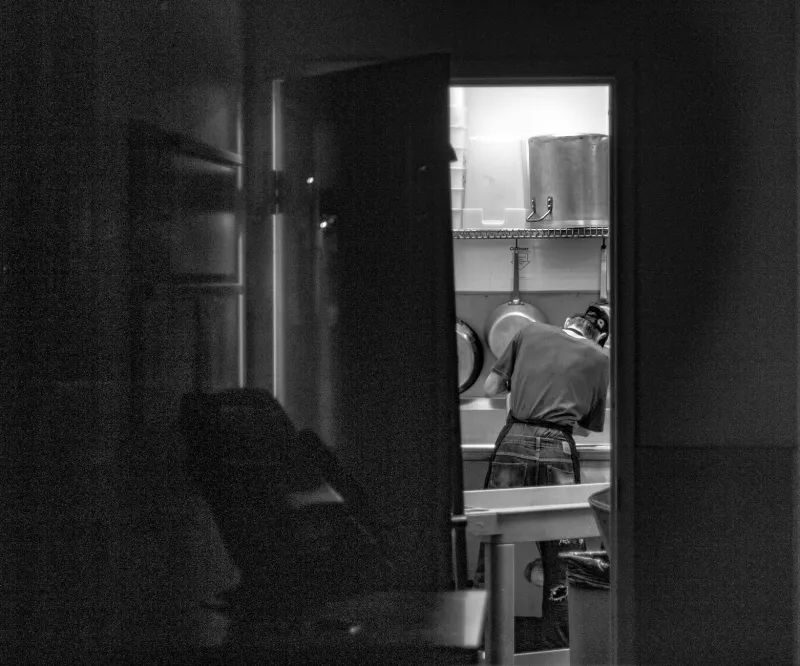
The Graveyard Shift Inventor
In 1934, while America clawed its way out of the Great Depression, Giuseppe Torrino stood elbow-deep in greasy dishwater at Romano's Italian Restaurant in Newark, New Jersey. The dinner rush had ended, leaving behind towers of plates and the familiar symphony of clinking glass and running water. But as Torrino scrubbed, his mind wandered to the paper bags piled near the kitchen's back door—discarded flour sacks that would soon become his canvas for revolution.
Most immigrants arriving in America during the 1930s focused solely on survival. Torrino was different. Between washing dishes and mopping floors, he observed everything: how the restaurant's ancient coffee percolator sputtered and died twice weekly, how the ice cream maker required three grown men to operate, how the can opener left jagged edges that cut fingers. Where others saw inconvenience, Torrino saw opportunity.
Sketching Dreams on Discarded Paper
Every night after his shift, Torrino would collect the cleanest paper bags from the restaurant's trash. By candlelight in his cramped tenement apartment, he transformed these humble canvases into detailed technical drawings. His neighbors thought he was mad—an uneducated dishwasher pretending to be an engineer.
They weren't entirely wrong about his credentials. Torrino had never set foot in an engineering school. He couldn't read blueprints, didn't understand patents, and had never heard of the American Society of Mechanical Engineers. What he possessed instead was something far more valuable: the outsider's eye.
While trained engineers designed appliances based on existing principles and industry standards, Torrino approached each problem as if he were the first person to encounter it. His coffee percolator design didn't follow conventional brewing wisdom—it eliminated the need for precise timing by automatically stopping the brewing process when optimal strength was reached. His can opener didn't just cut metal; it sealed the cut edge to prevent injuries.
The Breakthrough That Changed Everything
Torrino's eureka moment came during a particularly brutal summer in 1936. The restaurant's ice cream maker had broken down again, and customers were demanding frozen desserts despite the sweltering heat. Watching the frustrated cook manually crank a backup machine, Torrino realized that all existing ice cream makers fought against physics rather than working with it.
That night, on the back of a torn flour bag, he sketched a revolutionary design: an ice cream maker that used the natural expansion of freezing water to power its own churning mechanism. No electricity, no manual cranking, no complex gears—just ingenious simplicity.
The idea was so counterintuitive that when Torrino finally saved enough money to visit a patent attorney in 1937, the lawyer initially refused to file the application. "This violates basic thermodynamic principles," the attorney declared. Torrino's broken English couldn't articulate the science, but his working prototype—built from restaurant scraps and salvaged parts—spoke volumes.
From Kitchen Scraps to Corporate Boardrooms
The patent was approved in 1938, just as America began climbing out of the Depression and families started investing in modern kitchen conveniences. Torrino's self-churning ice cream maker caught the attention of Westinghouse, but the corporate executives who visited his tenement apartment weren't prepared for what they found.
Here was a man who had never read an engineering textbook, yet had solved problems that had stumped their entire R&D department. His apartment was filled with working prototypes built from coffee cans, coat hangers, and restaurant equipment—each one representing a potential goldmine.
Westinghouse offered to buy his ice cream maker patent for $500. Torrino, who had never seen that much money at once, almost accepted. Then his neighbor, a night-school law student, explained what patents were really worth. "You're not just selling a machine," she told him. "You're selling the idea behind every machine."
The Patent Portfolio That Quietly Shaped America
Armed with this new understanding, Torrino began licensing his inventions rather than selling them outright. His self-churning ice cream maker became the foundation for dozens of kitchen appliances. The automatic coffee percolator evolved into programmable coffee makers. His injury-proof can opener design influenced safety standards across the industry.
By 1955, Torrino held 127 patents—more than many corporate research divisions. His inventions appeared in kitchens across America, though few people knew his name. He preferred it that way, content to collect royalty checks while continuing to work at Romano's restaurant, sketching new ideas on paper bags.
The Advantage of Not Knowing Better
Torrino's success stemmed from his fundamental misunderstanding of how innovation was supposed to work. He didn't know that certain problems were considered "unsolvable" by industry experts. He hadn't been trained to think within existing paradigms or follow established protocols. His ignorance of conventional wisdom became his greatest asset.
When General Electric's engineers struggled for years to create a quiet garbage disposal, Torrino solved it in six weeks. His solution—redirecting sound waves through the unit's own grinding chamber—violated acoustic engineering principles but worked perfectly. "Sometimes," he told a reporter in 1960, "not knowing the rules means you can break them without feeling guilty."
Legacy of the Unlikely Legend
Giuseppe Torrino died in 1973, still washing dishes at Romano's restaurant. His obituary in the Newark Star-Ledger mentioned his 40-year career in food service but said nothing about his patents. Yet walk into any American kitchen today, and you'll find his innovations everywhere: automatic coffee makers, safe can openers, efficient ice cream makers, quiet garbage disposals.
His story reminds us that expertise can be a limitation as much as an asset. Sometimes the most revolutionary ideas come not from those who know everything about a field, but from those who know just enough to recognize a problem and naive enough to believe they can solve it.
In an age of specialized knowledge and corporate R&D departments, Torrino's paper bag sketches prove that innovation doesn't require credentials—just curiosity, persistence, and the willingness to see possibilities where others see only problems.