When David Beat Goliath: The Courtroom Underdogs Who Sued Their Way to Fortunes
The Sharecropper Who Owned the Sky
Jesse Thornton had never owned more than the clothes on his back when he filed the lawsuit that would make him a millionaire. It was 1963, and Jesse worked a small plot of cotton in rural Georgia under an arrangement that kept him perpetually in debt to the landowner. But Jesse had noticed something the lawyers in Atlanta hadn't: the new interstate highway system was cutting right through property that technically belonged to the federal government, not the private landowners who'd been collecting rent on it for decades.
The case seemed hopeless. Jesse was a Black sharecropper in the Jim Crow South, going up against white landowners with connections to the state legislature. His court-appointed lawyer advised him to drop the suit. But Jesse had done something his opponents hadn't: he'd actually read the original land grants from the 1800s.
Turns out, a surveying error from 1847 had left a strip of valuable land in legal limbo. When the federal government exercised eminent domain for the highway, they inadvertently clarified the ownership question – in Jesse's favor. The settlement didn't just give him money; it gave him clear title to 847 acres of prime real estate that became the foundation for the largest Black-owned trucking company in the Southeast.
Jesse's victory opened a legal floodgate. Dozens of similar cases emerged across the South, as sharecroppers and tenant farmers discovered that the land they'd been working for generations had murky ownership histories. Jesse became an unlikely expert in property law, consulting on cases that would eventually transfer millions of acres from absentee landlords to the families who'd actually worked the soil.
The Seamstress Who Stitched Together Justice
Maria Santos arrived in New York from Puerto Rico in 1954 with a sewing machine and a sixth-grade education. She found work in a garment factory in the Bronx, earning piece-rate wages for twelve-hour days in conditions that hadn't improved much since the Triangle Shirtwaist Fire. But Maria noticed something her coworkers had missed: the factory was using a patented sewing technique without paying royalties to the inventor.
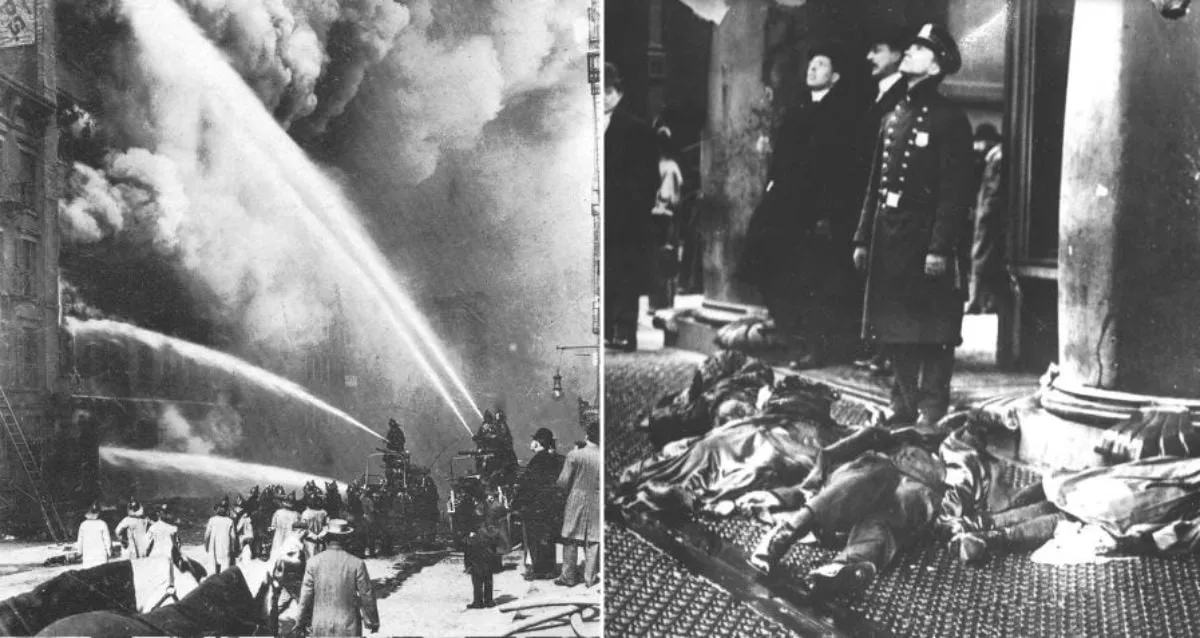 Photo: Triangle Shirtwaist Fire, via allthatsinteresting.com
The patent holder was a small company in Pennsylvania that had no idea their technique was being used by dozens of garment manufacturers across the Northeast. Maria's lawsuit on behalf of the patent holder seemed quixotic – how could a seamstress with limited English prove industrial-scale patent infringement?
But Maria had an advantage her opponents didn't expect: she understood the work better than anyone in the courtroom. She could demonstrate exactly how the patented technique differed from standard methods, and she had documented evidence of its use across multiple factories. Her testimony was so compelling that the case became a landmark in patent law.
The settlement made Maria rich, but it also made her powerful. She used her winnings to open her own garment factory, but this one was different. Maria offered profit-sharing to her workers, health insurance, and reasonable hours. When other factory owners complained that her model was unsustainable, Maria proved them wrong by consistently underbidding their contracts while paying her workers better.
By the 1970s, Maria's company was the largest Hispanic-owned manufacturer in New York City. Her legal victory had given her the capital to build a business empire, but more importantly, it had shown her that the system could be changed from the inside.
The Veteran Who Fought the Pentagon and Won
Tommy Rodriguez came back from Vietnam with shrapnel in his leg and a Purple Heart on his chest. The VA classified his injuries as minor and offered him a small disability payment. But Tommy had kept every piece of paperwork from his service, and he noticed discrepancies between his medical records and the official reports filed by his commanding officers.
Tommy's lawsuit against the Department of Defense seemed like a lost cause. He was claiming that military doctors had deliberately downgraded injury reports to reduce compensation payments – an accusation that would require taking on the entire military medical establishment.
But Tommy had something his opponents didn't: the methodical record-keeping skills the Army had taught him. He had documented every medical appointment, every treatment, every conversation with VA officials. When his case went to trial, Tommy presented a paper trail that revealed systematic fraud in military medical reporting.
The case exploded into a national scandal. Congressional hearings revealed that Tommy's experience was part of a wider pattern of medical fraud that had cheated thousands of veterans out of proper compensation. The settlement not only gave Tommy a substantial payout but also led to a complete overhaul of military medical reporting.
Tommy used his settlement to start a consulting company that helped other veterans navigate the VA system. His insider knowledge of military bureaucracy made him invaluable to veterans seeking proper compensation for their injuries. Within a decade, Tommy's company was handling thousands of cases annually and had recovered millions in benefits for veterans who'd been shortchanged by the system.
The Teenager Who Took on Corporate America
Sarah Kim was seventeen when she filed the lawsuit that would change her life forever. She was working part-time at a fast-food restaurant to help support her immigrant family when she discovered that her employer was systematically underpaying teenage workers by classifying them as "trainees" even after months of regular employment.
Sarah's case seemed hopeless for multiple reasons: she was a minor, her family couldn't afford a lawyer, and she was going up against a corporation with unlimited legal resources. Most people advised her to just find another job.
But Sarah had something her opponents underestimated: she was fluent in both Korean and English, and she'd been translating legal documents for other immigrant families in her community. She understood labor law better than most adults, and she had documentation of the wage theft affecting dozens of teenage workers.
Sarah's lawsuit became a class action that ultimately covered thousands of teenage workers across multiple states. The settlement was massive, but more importantly, it established new precedents for protecting young workers from exploitation.
Sarah used her portion of the settlement to put herself through law school, but she also started a nonprofit organization that provided legal assistance to immigrant families. By her thirties, Sarah was running one of the most successful immigration law practices on the West Coast, built on the foundation of a lawsuit everyone said she couldn't win.
The Factory Worker Who Exposed the Cover-Up
Robert Chen had worked at the chemical plant for fifteen years when he was laid off in a round of "cost-cutting" measures. But Robert suspected the real reason for the layoffs: the company was trying to silence workers who'd been exposed to dangerous chemicals and were starting to develop health problems.
Robert's wrongful termination lawsuit seemed like a standard employment case until his lawyer discovered something explosive: internal company documents showing that management had known about the health risks for years and had deliberately concealed them from workers.
The case transformed from a simple wrongful termination suit into a massive toxic tort action covering hundreds of workers and their families. Robert's meticulous documentation of safety violations and health symptoms became the foundation for a case that would ultimately cost the company hundreds of millions in settlements and fines.
Robert used his settlement to start an environmental consulting company that specialized in workplace safety. His insider knowledge of industrial processes and his experience with corporate cover-ups made him invaluable to other workers facing similar situations. Within a decade, Robert's company was working with unions, government agencies, and advocacy groups across the country to expose and prevent workplace health hazards.
When Justice Becomes a Business Plan
These five stories share a common thread: ordinary people who refused to accept that the system was stacked against them, and who discovered that fighting back could be not just morally right, but financially transformative. Each of these individuals turned their legal victories into the foundation for business empires that grew far beyond their original settlements.
More importantly, each of them used their success to change the systems that had initially excluded or exploited them. They proved that sometimes the best way to beat the system isn't to join it – it's to build a better one.
In an America that often seems dominated by corporate interests and institutional power, these stories remind us that individual courage and determination can still move mountains. Sometimes all it takes is one person willing to file the lawsuit that everyone says can't be won.