The Dressmaker's Empire: How a Free Black Woman in Antebellum Charleston Secretly Owned the Block
A City Built on Contradictions
Antebellum Charleston was a city of spectacular contradictions. It was one of the wealthiest cities in North America, its prosperity built on the labor of enslaved people, its streets lined with some of the most architecturally refined buildings in the country. And within that city, there existed a small, precarious, and largely invisible community: free Black residents who occupied a strange middle ground — technically free, practically constrained at nearly every turn by a legal system designed to ensure they remained so.
They could not vote. They could not testify in court against white citizens. They faced strict curfews and registration requirements. And critically, free Black women in South Carolina could not, under the law, enter into contracts or hold real property in their own names.
For most women in that community, those restrictions formed the outer walls of what a life could contain. For a dressmaker historians now know as Cecelia Marchande, they became, instead, a design problem to be solved.
The Needle and the Ledger
Marchande ran what contemporaries described as one of the finest dressmaking operations in the city. Her clientele was drawn from Charleston's white planter class — the same class whose legal and political power made her own freedom so fragile. She dressed their wives and daughters for balls and weddings and society events, and she was compensated accordingly. Her work commanded prices that reflected genuine artistry.
What she did with that income is where her story becomes remarkable.
Marchande could not deposit money in a bank under her own name. She could not purchase property directly. She could not sign a lease or a deed. So she found people who could — a small network of white individuals, some of them clients, some of them tradesmen she had come to trust through years of careful observation — and she funneled her earnings through them.
The arrangement was not unusual in its basic form. Free Black residents throughout the antebellum South sometimes used white intermediaries to navigate legal restrictions. What made Marchande's version of this practice extraordinary was its scale, its discipline, and the degree of control she maintained over every transaction despite never appearing on a single document.
Properties were purchased in the names of her intermediaries. Rents were collected by them. Repairs were authorized by them. But the decisions — which properties to buy, what to charge, when to sell, how to reinvest — were hers. Entirely hers.
The Architecture of Invisibility
How do you control an empire you're not allowed to own? Marchande's answer was relationships, and the meticulous management of trust.
She chose her intermediaries with extraordinary care. A white seamstress supply merchant who owed her a significant informal debt. A widow of a former client who had been left in reduced circumstances and welcomed the arrangement's modest financial benefits. A free Black man — one of the few in the city legally permitted to hold property — who served as a second layer of the network for certain transactions.
She maintained what amounted to a shadow ledger: a private accounting of what she owned, what it earned, and what was owed to her — kept not in a formal book but in a system of memory and notation that historians have only partially reconstructed. She could not afford a paper trail that might be discovered and used against her. She operated in the space between what the law allowed and what it could see.
By the 1850s, Marchande's network controlled multiple properties on and near a single block in a commercially active part of Charleston. She was, in any functional sense, a significant property owner. The law simply had no language for what she was.
The Discovery
For more than a century after the Civil War, Cecelia Marchande was a ghost. Her name appeared nowhere in the histories of Charleston's antebellum business community. The properties she had controlled passed through the chaos of Reconstruction and the decades that followed, their origins thoroughly obscured.
She surfaced, almost by accident, in the 1970s.
A historian named Ruth Pemberton was researching the economic networks of free Black Charlestonians when she began cross-referencing property records with a collection of private correspondence held in a South Carolina archive. In a ledger belonging to one of Marchande's intermediaries — a document catalogued simply as "household accounts" and largely overlooked by previous researchers — Pemberton found a set of notations that didn't fit the ledger's ostensible owner.
The handwriting changed. The property references were too numerous and too specific. And then, in a margin entry dated to the mid-1840s, a name: C. Marchande — her portion — to be held.
Pemberton spent the next several years pulling on that thread. What she reconstructed was incomplete — Marchande's deliberate invisibility had done its work too well — but the outline that emerged was unmistakable. A free Black woman had quietly accumulated real estate holdings that would have made her one of the more significant property owners on her block, at a time when the law had done everything in its power to make that impossible.
What the Needle Knew
There's something almost poetic about the specific nature of Marchande's work. Dressmaking, in antebellum Charleston, put her in intimate proximity to the city's most powerful families. She knew their finances — you can't dress a family for years without learning whether money is tight or plentiful. She knew their social obligations, their ambitions, their anxieties. She was present in their homes in a way that made her, simultaneously, invisible and indispensable.
That access was information. And Marchande, it seems, knew exactly how to use it — not to harm anyone, but to read the city's currents well enough to know which properties were worth acquiring, which relationships were worth cultivating, and which risks were worth taking.
Her story sits at the intersection of several American narratives that rarely get told together: the story of Black economic ingenuity under conditions of brutal legal suppression; the story of women building wealth in an era that denied them the tools to do so; and the story of how much of American history has been hidden not by dramatic erasure but by simple misfiling — by ledgers catalogued as "household accounts" and left on archive shelves for a hundred years.
The Block That Remembers
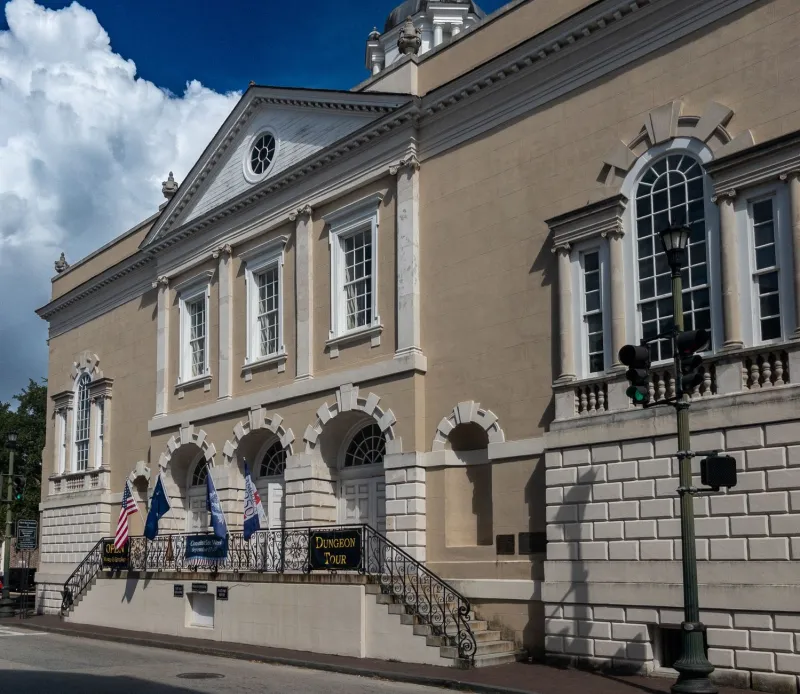
Charleston today preserves much of its antebellum architecture with considerable pride. Tourists walk the same streets Marchande walked. Some of the buildings that stand there may trace their ownership history, however indirectly, back through her invisible ledger.
She left no memoir. No portrait is known to exist. The full scope of what she built may never be recovered.
But she built it. Thread by thread, property by property, through a system designed to make her invisible — using that very invisibility as her most reliable tool. In a city that spent decades telling a particular story about who built it and who owned it, Cecelia Marchande's life is a quiet, stubborn correction.