Quarters, Notebooks, and Dynasties: How Five Immigrant Families Turned Laundromats Into Empires
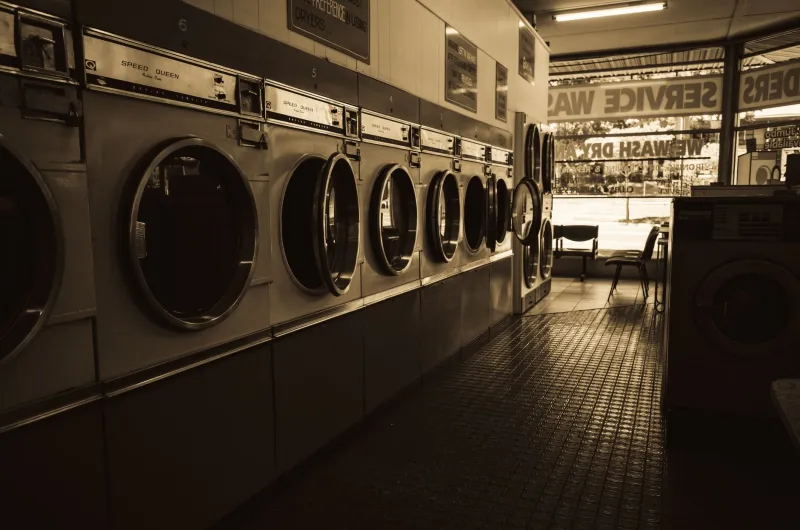
There's a particular kind of American education that happens not in lecture halls or corporate training programs, but in the fluorescent-lit, linoleum-floored world of the coin-operated laundromat. It's an education in patience, in human behavior, in the mathematics of small margins and high volume, in what it means to show up every single day for a business that never closes and never stops demanding your attention.
For generations of immigrant families, the neighborhood laundromat wasn't just a business. It was a graduate school in disguise. And for these five families, the lessons learned between the spin cycle and the dryer buzzer became the foundation for something nobody — least of all them — ever expected.
1. The Nguyen Family: From Coin Slots to Commercial Real Estate
When Thanh Nguyen arrived in Houston in 1981 with her husband and two young children, the laundromat they scraped together enough to lease in a strip mall on the city's west side was, by any objective measure, a modest operation. Twenty-two machines. A change dispenser that jammed twice a week. A folding table that listed to the left.
What made the Nguyens different was the notebook. Thanh kept a handwritten ledger — not just of income and expenses, but of patterns. Which machines ran longest on Saturdays. Which customers came back weekly versus monthly. Which detergent brands people brought from home versus which they bought from the vending machine on the wall. She tracked foot traffic by hour, by day, by season.
Within three years, she understood the strip mall she was renting in better than the landlord did. She knew exactly which businesses drew traffic at which hours, which storefronts sat half-empty, and why. When the landlord decided to sell, Thanh's data-driven intuition told her the property was undervalued. She found a way to buy it. Then the next one. Today, the Nguyen family's commercial real estate portfolio covers over forty properties across greater Houston. The original laundromat is still operating. Thanh still stops by occasionally, though she no longer needs to.
2. The Okafor Family: The Laundry Kings Who Built a Bank
Emeka Okafor came to Chicago from Nigeria in 1976 with an engineering degree that American employers declined to recognize and a determination that nobody could take from him. He and his wife, Adaeze, opened their first laundromat in the South Shore neighborhood in 1979, deliberately choosing a community that larger businesses had already written off.
What Emeka brought to the business was an engineer's obsession with systems. He redesigned the customer flow through the space, reducing average wait times. He created a maintenance schedule so rigorous that his machines had half the downtime of competitors. He also noticed something that would change his family's trajectory entirely: his customers had almost no access to basic banking services. They cashed checks at predatory currency exchanges. They kept savings in shoeboxes. They had nowhere to go.
Emeka spent eight years building relationships, learning finance through night classes and library books, and quietly accumulating capital from the laundromat's steady returns. In 1991, the Okafor Community Credit Union opened its doors three blocks from the original laundromat. It now serves thousands of members across Chicago's South Side, with assets that would have seemed like a fantasy to the man who once fixed washing machines at midnight to save a service call fee.
3. The Reyes Family: Detergent Displays and a Retail Dynasty
Gloria Reyes didn't mean to become a retail entrepreneur. She meant to survive. When she and her husband Marco opened their laundromat in East Los Angeles in 1988, their profit margins were thin enough to read a newspaper through. To supplement income, Gloria started selling small household items from a folding table near the entrance — detergent, fabric softener, dryer sheets, small sewing kits.
She noticed something almost immediately. Her customers, many of them recent immigrants like herself, would buy anything that solved a specific household problem, if the price was right and someone they trusted was selling it. She began expanding the table. Then it became a shelf. Then a small room partitioned off from the laundry floor. By 1995, the laundry machines were an afterthought.
The Reyes family now operates a regional chain of household goods stores across Southern California, with a supply chain that Gloria built herself over twenty years of obsessive vendor negotiation. She still talks about the folding table. Her children, who run the business now, keep a photograph of it in the company headquarters. It hangs next to the revenue projections for next year, which contain a number that would have made 1988 Gloria laugh until she cried.
4. The Patel Family: The Franchise Blueprint Hidden in the Spin Cycle
Ravindra and Meena Patel opened their first laundromat in suburban Atlanta in 1984, the same year they arrived from Gujarat. Like many of the families in this story, they kept meticulous records. Unlike most, Ravindra was specifically tracking something unusual: the replicability of everything they did.
He wanted to know which of their operational decisions were genuinely transferable — which systems would work just as well in a different location, run by a different family member, without him standing over it. He was, without knowing the vocabulary for it, designing a franchise model from scratch, tested first in the laboratory of a single coin-operated laundromat.
By 1992, the Patels had five laundromats across the Atlanta metro area, each run by a different branch of the extended family, each operating from the same operational manual Ravindra had written by hand. By 2000, they had pivoted the model to hospitality, opening the first of what would become a regional chain of budget hotels. The operational DNA — the obsessive systemization, the family-unit management structure, the relentless reinvestment — traced directly back to that first laundromat in 1984. The hospitality industry, of course, already had a name for what the Patels had quietly reinvented. They just didn't know it yet.
5. The Kim Family: Customer Loyalty, Learned One Load at a Time
Jung-Ho Kim arrived in Queens, New York, in 1971 speaking almost no English and carrying a skillset that had no obvious American application. He'd been a schoolteacher in Seoul. In New York, he became a laundromat attendant, then a co-owner, then the sole owner of a small operation in Flushing that he ran for nearly two decades.
What Jung-Ho mastered, over those twenty years, was the art of making people feel known. He remembered names. He remembered which machines customers preferred. He noticed when regulars missed a week and asked about them when they returned. The laundromat became, in a real sense, a community institution — a place people trusted, returned to, and recommended.
When Jung-Ho's daughter, Susan, graduated from Fordham with a business degree in the early 1990s, she took those same principles and applied them to something newer: a small dry-cleaning chain that competed not on price but on relationship. The Kim family's loyalty-first model — born in a Queens laundromat where her father remembered every customer's name — became the operational philosophy of a business that eventually expanded to multiple states.
Susan has given talks about customer retention at business conferences. She always mentions the laundromat. She says it's where her family learned that loyalty isn't a marketing strategy. It's a practice. And her father practiced it for twenty years before anyone thought to call it a competitive advantage.
The Classroom That Never Closed
None of these families set out to build empires. They set out to make rent, to feed their children, to survive in a country that didn't always make survival easy. The laundromat was what was available — low barrier to entry, constant demand, unglamorous enough that nobody else particularly wanted it.
But the laundromat, it turns out, teaches everything. It teaches margin management and customer behavior and operational consistency and the compounding power of reinvestment. It teaches you to show up every day for a business that will not reward you unless you do. It teaches patience in the way that only a slow, steady, quarters-at-a-time business can.
The most extraordinary classrooms, it seems, are often the ones with the worst lighting.