The Scrap Metal Dreamer Who Turned Broken Parts Into Childhood Magic
When Poverty Becomes Your Best Teacher
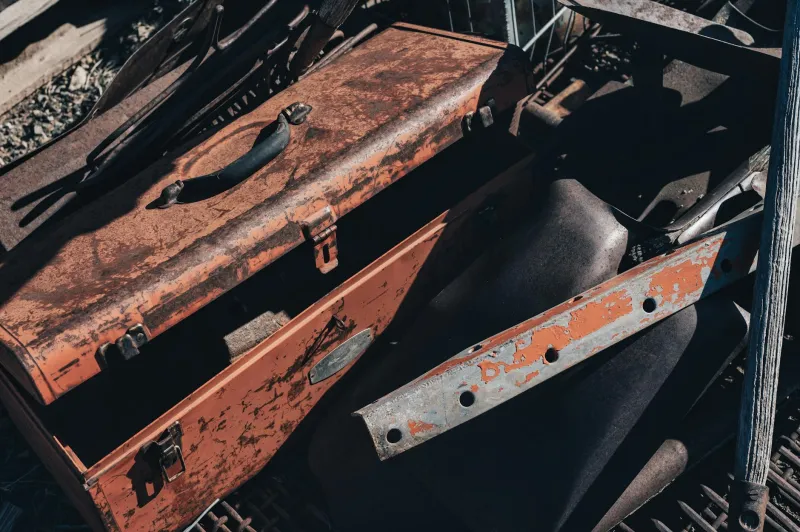
In the dust and rust of a Cleveland junkyard during the 1930s, a skinny kid named Harold was learning lessons that Harvard Business School couldn't teach. While other children played with store-bought toys, Harold spent his afternoons elbow-deep in twisted metal, broken machinery, and discarded car parts. His father ran the scrapyard, and Harold's job was simple: figure out what could be salvaged, what could be fixed, and what was truly worthless.
 Photo: Harvard Business School, via identity.hbs.edu
Most people saw junk. Harold saw possibilities.
Every bent piece of metal told a story. Every broken gear had a purpose waiting to be rediscovered. In a world where families counted pennies and nothing got thrown away unless it was absolutely beyond repair, Harold developed an almost supernatural ability to see how things fit together – and more importantly, how they could fit together differently.
The University of Making Do
The Great Depression wasn't just an economic disaster; it was a masterclass in resourcefulness. While wealthy families weathered the storm with their savings intact, working-class kids like Harold learned to create something from nothing. The junkyard became his laboratory, his playground, and his business school all rolled into one.
Harold's father noticed his son's gift early on. The boy could take a pile of seemingly random metal scraps and somehow fashion them into working tools, simple machines, or intricate mechanical puzzles. But more than that, Harold understood the fundamental principle that would later make him millions: the best toys weren't just fun to play with – they taught you how things worked.
"Fix it, don't replace it" wasn't just a family motto; it was survival. And in that survival, Harold was unknowingly developing the design philosophy that would change American childhoods forever.
From Scrap to Prototype
By his teenage years, Harold had moved beyond simple repairs. He was inventing. Using discarded materials from the junkyard, he created mechanical toys that moved, interlocked, and came apart in endless combinations. His creations weren't pretty – they were raw, industrial, and built to last. They looked like what they were: toys born from the working world, not the fantasy world.
When World War II arrived, Harold enlisted and found himself working as a mechanical engineer. The military loved his ability to improvise solutions with whatever materials were available. But Harold's mind kept drifting back to those junkyard days, to the simple joy of taking broken things and making them work again.
 Photo: World War II, via public.flourish.studio
After the war, as America entered an era of unprecedented prosperity, Harold watched parents buying increasingly elaborate toys for their children. But something bothered him about these pristine, pre-made playthings. They didn't teach kids anything except how to be consumers. They didn't spark the kind of creative problem-solving that had defined his own childhood.
Building an Empire from Broken Dreams
In 1949, Harold took his life savings – barely enough for a down payment on a small workshop – and started producing his own toys. They were unlike anything on the market: steel construction sets that looked more like miniature building supplies than traditional playthings. The pieces were simple, interchangeable, and virtually indestructible.
Toy store owners were baffled. These weren't cute or colorful. They didn't look like anything children would want. Harold's sales pitch was equally confusing: "These toys teach kids to build things that actually work."
The first year was brutal. Retailers dismissed Harold as an amateur who didn't understand the toy business. Parents complained that the sets were too complicated, too industrial-looking, too much like work and not enough like play. Harold watched his savings dwindle as boxes of unsold inventory gathered dust in his workshop.
But then something unexpected happened.
The Children Vote with Their Hands
The few children who did get Harold's construction sets became obsessed with them. They built bridges, cranes, vehicles, and structures that actually functioned. More importantly, they understood how they functioned. These kids weren't just playing; they were engineering.
Word spread slowly, parent to parent, child to child. Harold's toys had something that the flashier alternatives lacked: they grew with the child. A simple starter set could evolve into increasingly complex creations as the builder's skills developed. The same pieces that made a basic truck could be reconfigured into a working elevator, a functioning drawbridge, or a mechanical robot.
When the Industry Finally Noticed
By the mid-1950s, Harold's company had quietly become one of America's fastest-growing toy manufacturers. The major players in the industry, who had initially dismissed him as a small-time tinkerer, suddenly found themselves scrambling to create their own "educational construction toys." But they missed the essential ingredient: Harold's sets worked because they were designed by someone who truly understood how things broke, how they could be fixed, and how they could be improved.
The junkyard kid had grown up to give American children something precious: the confidence that they could build anything they could imagine, using tools and principles that would serve them for the rest of their lives.
The Legacy of Broken Things Made Whole
Today, Harold's company remains a household name, synonymous with creative construction and hands-on learning. Millions of children have learned basic engineering principles through toys that trace their DNA directly back to a Depression-era scrapyard in Cleveland.
But perhaps the most remarkable thing about Harold's story isn't his business success – it's how perfectly it embodies the American dream. In a country that often mistakes wealth for wisdom, Harold proved that the most valuable education sometimes comes from the humblest circumstances. The boy who learned to see potential in other people's discarded dreams grew up to give millions of children the tools to build their own.
Sometimes the best foundation for building the future is understanding how to fix what's broken in the present.